
Frederic C. Rupprecht
Co-founder & Managing Director, LEADBeyond GmbH
Former Associate Partner at McKinsey & Company. Responsible for the methodology and product behind LEADBeyond 360°.
Built by former McKinsey & Roland Berger consultants
The consultant-led 360° leadership assessment for consulting and professional-services firms: beliefs, capability, behaviour under pressure and outcomes in one picture – not another generic survey tool.
The platform
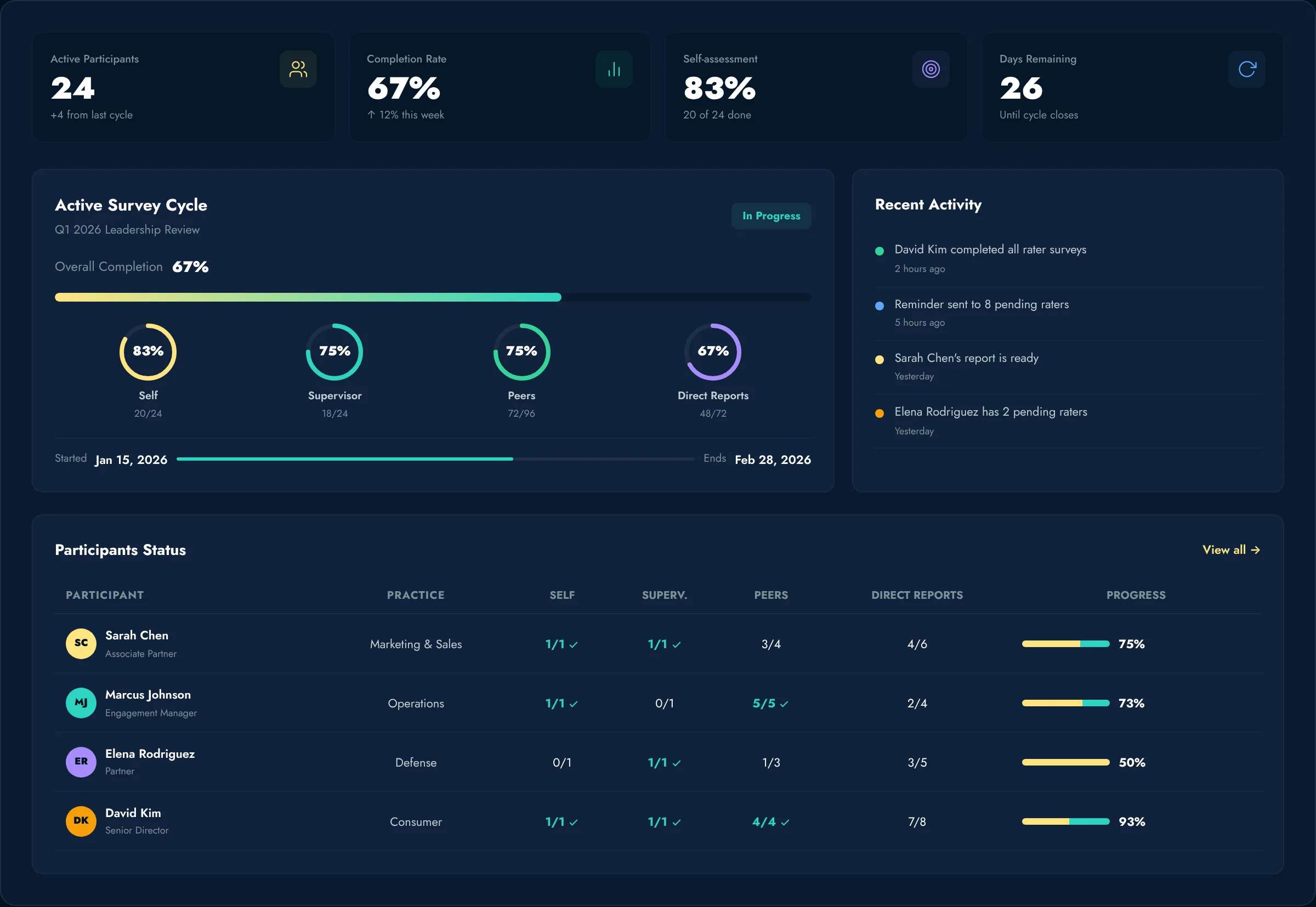
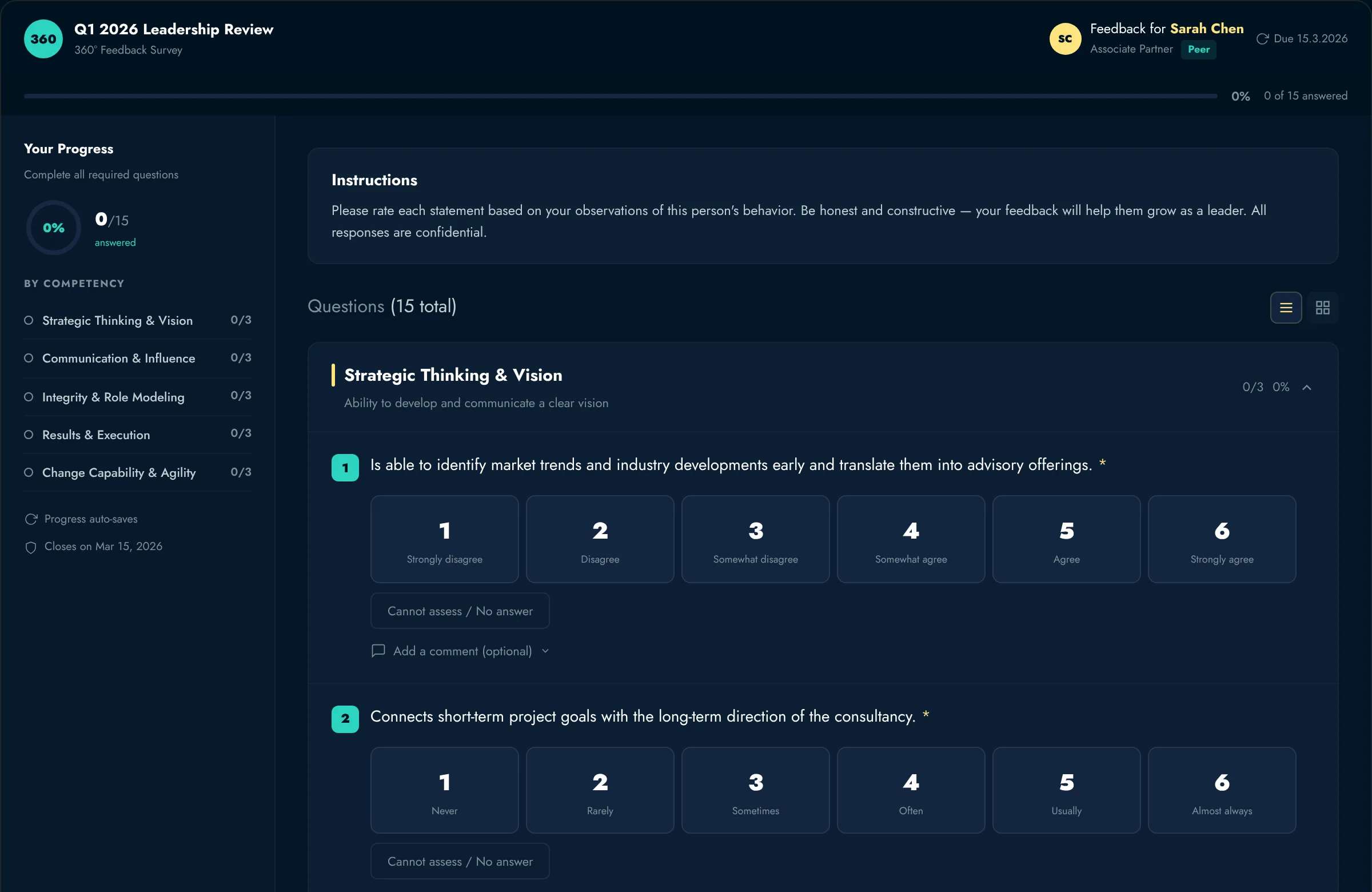
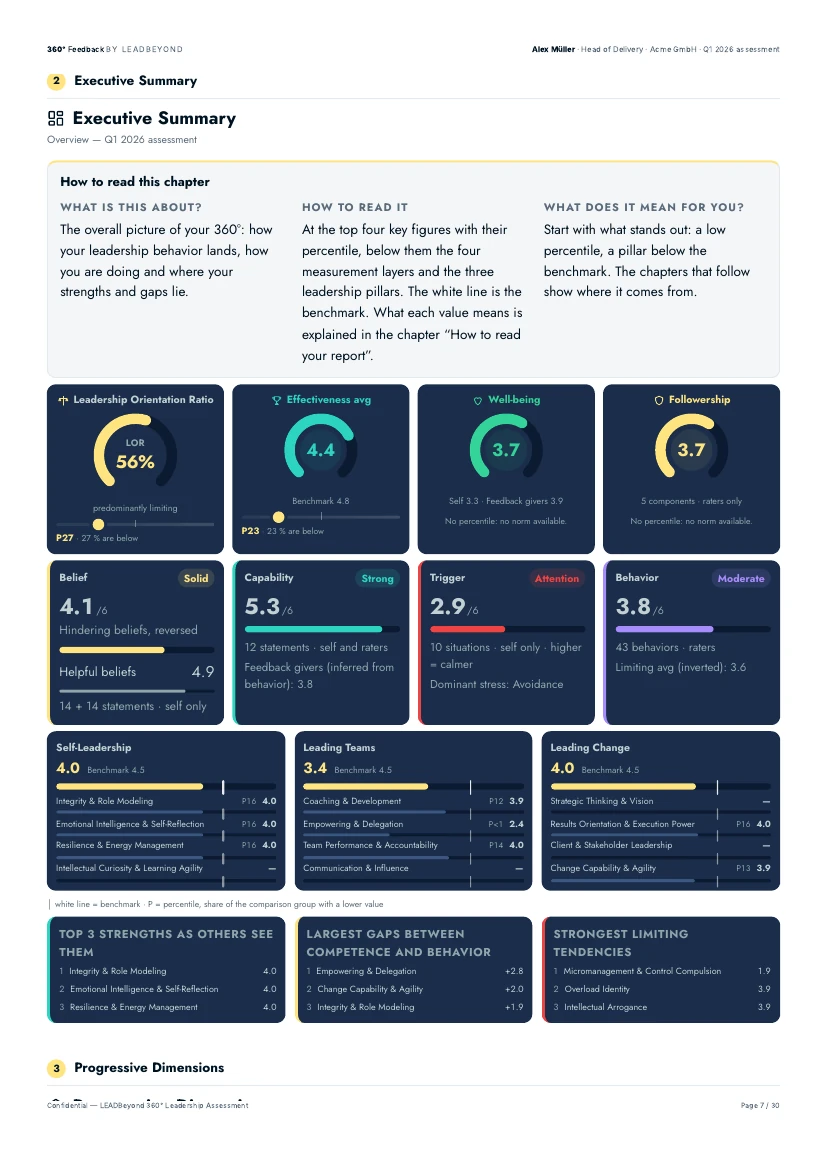
This is what LEADBeyond 360° looks like for the consultant team, the raters and the leader. Real screens, shown with sample data.
The Case for 360°
Most development budgets flow without a data baseline. Here's what that costs — and what changes when you fix it.
Without structured 360° feedback
87%
of leaders carry hidden blind spots
Their self-perception diverges materially from how peers and direct reports experience them — and those gaps go unaddressed for years.
Source: HBR / Tasha Eurich — 2018
3–5
unexpected leader departures per year
Disengaged leaders drive top-talent exits. Each departure costs 1.5–2× annual salary in replacement and lost momentum.
Source: SHRM Human Capital Benchmarking Report
70%
of corporate training fails to transfer to performance
Without a data baseline showing which gaps to close, training is allocated to programmes rather than people. Most spend misses the leaders who need it most.
Source: Association for Talent Development / Brandon Hall Group
With LEADBeyond 360°
87
blind spots surfaced, named and prioritised
Every hidden gap across your leaders — identified through peer, direct report and manager perspectives. Not guesswork. Data.
Source: Center for Creative Leadership, 2022
+23%
leadership effectiveness uplift within 12 months
Leaders acting on structured feedback show measurably higher effectiveness scores — assessed by the same peers and direct reports next cycle.
Source: CCL — Building Better Leaders, 2023
6–12×
ROI on your leadership development spend
Outcome-linked programs consistently outperform untargeted training. Retention savings alone at 100 leaders cover the program cost many times over.
Source: McKinsey / Deloitte L&D benchmarks
The bottom line
For a 50-leader programme, structured 360° typically unlocks
€180k – €450k
in annual retention savings — from 2–4% fewer unexpected leadership exits at 1.5× replacement cost
Add 6–12× ROI on your L&D budget for the full business case · Sources: SHRM, McKinsey / Deloitte
For consulting and professional services
In consulting and professional-services firms, client, partner and project pressure visibly changes how people lead. A behaviour questionnaire alone does not explain why.
Consultant-led, not self-service
A LEADBeyond consultant reviews every report before release and uses it as the starting point for a development conversation or coaching.
Anonymity enforced in the system
Rater groups are shown separately only once they reach a minimum number of responses. Your people team sees progress, never individual results.
Causes, not just symptoms
6 measurement layers from belief to outcome, 12 leadership dimensions, 99 items on a six-point scale.
Immutable, bilingual reports
Released reports never change. Questionnaire, report and platform in German and English.
We used to spend a week pulling together a leadership feedback report. Now we launch a full cycle, collect responses, and present a polished PDF report — all within the same week.
The difference
Most 360° feedback tools answer one question: what leadership behaviour do others observe? LEADBeyond 360° adds four more. The model links what a leader believes (Belief), what they trust themselves to do (Capability), what throws them off under pressure (Trigger), what their environment actually experiences (Behavior) and the effect that has (Outcome) – with Well-being as the energy buffer that decides how much pressure a leader can absorb before patterns flip.
A classic 360° answers
LEADBeyond 360° additionally answers
Who built this
LEADBeyond was founded by former strategy consultants from McKinsey & Company and Roland Berger. The method, the questionnaire and the report structure come from working with leaders under real client and project pressure.
Frederic C. Rupprecht
Co-founder & Managing Director, LEADBeyond GmbH
Former Associate Partner at McKinsey & Company. Responsible for the methodology and product behind LEADBeyond 360°.

Jonathan Günak
Co-founder & Managing Director, LEADBeyond GmbH
Former Principal at Roland Berger. Works with clients on the selection, design and delivery of 360° programmes.
What this means for you: You talk to people who know your world – from the first call to the debrief.
From nominating raters to the debrief – in one platform, accompanied by people.
Four perspectives
Self-assessment, supervisors, peers and direct reports in one structured cycle.
Anonymity threshold
Groups are shown separately only above a minimum number of responses; free text is never attributed to a person.
A 12-view report
Interactive report with PDF export, self and others side by side, built for the conversation.
Behaviour under pressure
Stress triggers and pattern hypotheses – explicitly hypotheses for the conversation, not a diagnosis.
Automatic reminders
Invitations and reminders to raters run through the platform; response progress is visible per group.
Hosted in Frankfurt
GDPR-oriented architecture, hosted in Frankfurt am Main, anonymity enforced in the scoring.
How it works
Five steps, from set-up to development. The consultant team accompanies each of them.
Set up
Objectives, the group of leaders, rater groups, anonymity threshold and timeline – together with your consultant.
Nominate
The leader, the consultant team or both name the raters, with recommended minimums per group.
Survey
Self-assessment in about 18 minutes, rater feedback in 10 to 15 minutes, on mobile and desktop.
Review
The platform scores within the anonymity rules; every report is reviewed and released.
Develop
The report is the basis for the development conversation or coaching. Repeat cycles show change over time.
What coaches and leadership consultants say about delivering 360° feedback with LEADBeyond.
The platform changed how we deliver leadership programs. Our clients love the visual reports — and the anonymity settings mean people give genuinely honest feedback.
Setting up a feedback cycle used to take us days of spreadsheet work. Now we're live in under an hour. The white-label PDF reports have become a flagship part of our coaching programs.
The radar charts and self-vs-others comparison have become the centerpiece of every coaching debrief. It's the most polished feedback tool we've used — and we've evaluated many.
Insights
Before you set up a 360° programme
Anonymity, rater selection, interpretation, vendor comparison – answers to the questions that precede every decision.
Trust & governance
Is 360° feedback anonymous? Anonymous in the answers, confidential in participation
Anonymous in the answers, confidential in participation: what the anonymity threshold does, why written comments are the weak point, and what you can honestly promise raters.
Read more →Fundamentals
How many raters does 360° feedback need – and why two is only the floor
Two responses per rater group are the anonymity floor, three or more the target. What the research says, and how to handle a single supervisor and small teams.
Read more →Comparison & selection
360° feedback software compared: choose the category before the vendor
Survey tools, HR suites with a 360 module, specialist platforms and consultant-led providers: what each documents, where they differ and which category fits you – no ranking.
Read more →Book a demo
Pick a time and we'll walk through the platform together – tailored to what you need. No slides, just the actual product.
Choose a time that works
The link opens our booking calendar. You'll see all free slots and can confirm in a minute.
Book a demoOpens Google Calendar · free · no account needed
Prefer email? talents@LEADBeyond.de · Contact